
October 2025 is shaping up to be one interesting month for sky watchers. Besides the awesome Orionids Meteor Shower (peaking on the 21st), we also have two spectacular, potentially naked-eye, comets approaching their peak brightness, AND we’re hosting a guest from beyond our own solar system!
We will dive into the Orionids soon but for now- Here’s your guide on how to spot Comet Lemmon, Comet SWAN, and the mysterious interstellar object 3I/ATLAS this month.
🚀 Part 1: 3I/ATLAS- The Interstellar Object Whizzing Through Space Directly Towards Earth
It's true: a complete stranger from beyond our solar system is visiting our neck of the galaxy- and it’s passing through our planetary neighborhood right now. First spotted in July 2025 by the ATLAS (Asteroid Terrestrial-impact Last Alert System) telescope in Chile, this mysterious visitor has had everyone talking. Here's what you should know…
What Does “Interstellar” Even Mean?
It’s all in the name—“interstellar” means this object hails from beyond the gravitational reach of our Sun. Our solar system is, at its core, one star and a host of companions—planets, asteroids, and comets—locked into its pull, orbiting in a cosmic dance.
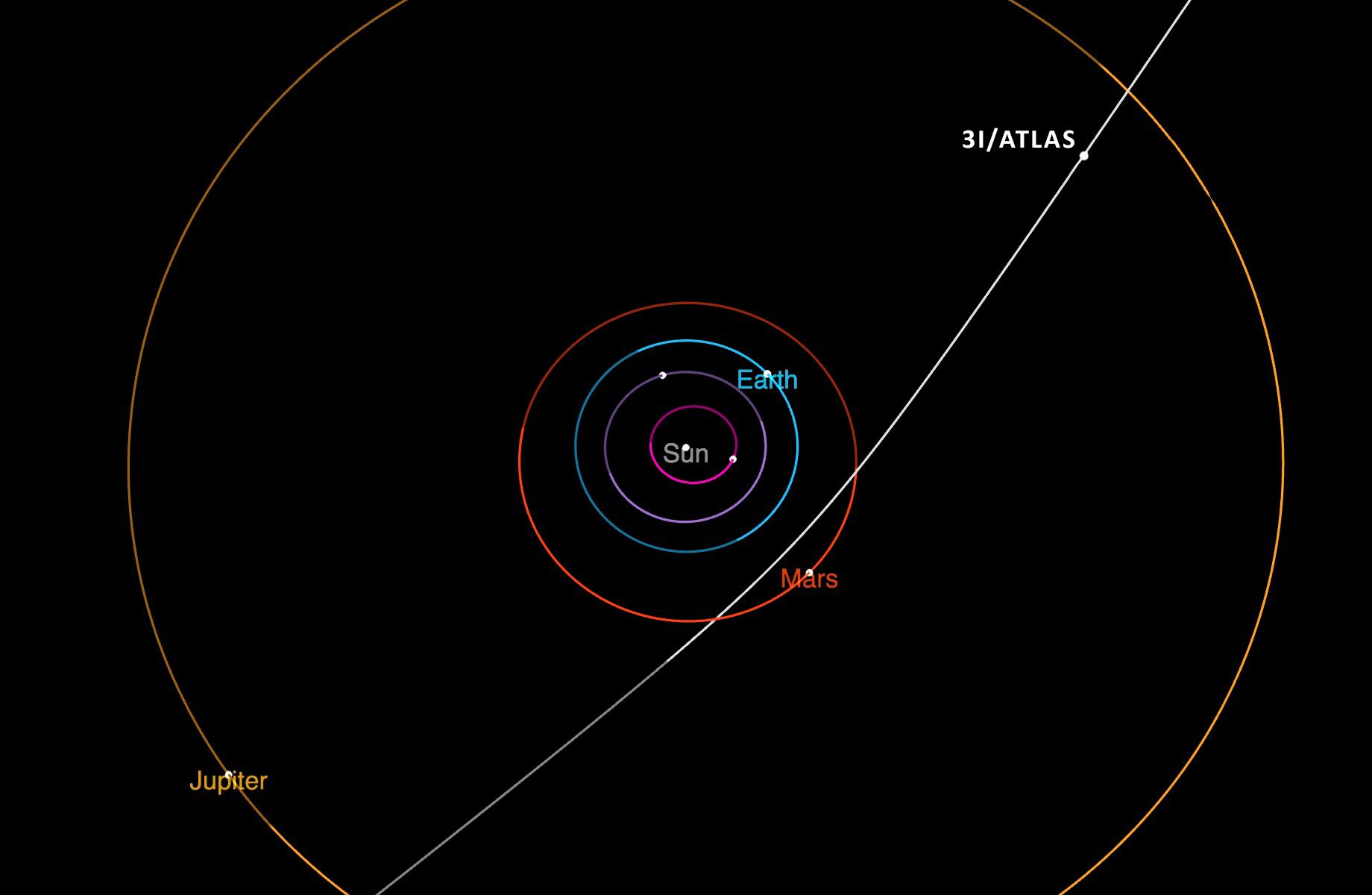
But this object is different. Unlike our bound celestial bodies, this one has a hyperbolic trajectory: a sling-shot arc that whips it around the Sun and flings it back into the deep unknown, never to return. So while the residents are all circling the sun, this is clearly a visitor because it is not. It is moving very fast and heading in a completely different direction than everything else. It's an untethered wanderer just passing through.
This is not the first confirmed interstellar object we have ever hosted, either. In fact, it’s the third- following the first, I/ʻOumuamua (2017) and the second, I/Borisov (2019). The name 3I/ATLAS simply means it's the 3rd Interstellar object discovered by the ATLAS program.
Could This Alien Visitor Be a Spaceship?
When astronomers first spotted 3I/ATLAS some red flags were raised and plenty of people were wondering if this could be some kind of alien messenger. Its extreme speed was one red flag- it’s traveling at 58 km/s (over 210,000 km/h) relative to the Sun. The highly unusual path was red flag number 2 and that sparked intense speculation. Harvard astrophysicist Dr. Avi Loeb, who also weighed in on ʻOumuamua, even suggested it could be a technological object, like an alien light sail.
However, the scientific consensus is in:
The evidence: As it got closer, 3I/ATLAS began forming a coma and tail—clear signs of an icy body sublimating. Instruments like the James Webb Space Telescope detected water, carbon monoxide, and carbon dioxide—the chemical fingerprints of a natural comet.
The conclusion: Despite the buzz, scientists agree that 3I/ATLAS is a natural interstellar comet, possibly 11 billion years old, hailing from the Milky Way's ancient stellar disk.
What We Know About This Ancient Comet
Size: Estimated between 440 meters and 5.6 kilometers wide.
Path: It recently swept past Mars and will make its closest approach to the Sun (perihelion) on October 29, 2025, passing just inside Mars's orbit.
Danger? Absolutely none. It will come no closer than 1.6 AU (about 240 million km) to Earth, which is over 1.5 times the distance between the Earth and the Sun.
Current Status of 3I/ATLAS
Comet 3I/ATLAS is currently very close to the Sun in our sky, approaching solar conjunction. As of the time of this writing (October 15, 2025), it is unobservable from Earth for a few weeks because the Sun's glare is completely washing it out.
Its closest approach to the Sun (perihelion) will occur on October 29, 2025, just before it reappears on the other side of the solar system from our perspective. The only way to "watch it travel live" from Earth right now is to consult interactive trackers, such as NASA's Eyes on the Solar System, which show its theoretical path.
☀️ An Astrological Analogy: Combust and Cazimi
The comet's current unobservable status is a perfect astronomical demonstration of the astrological concepts of combustion and cazimi—a time when a body's visibility is entirely dependent on its angular separation from the Sun.
Combustion 🔥
When a celestial body (like 3I/ATLAS or a planet) is within a certain angular distance of the Sun, it is considered combust.
Astronomically: We cannot see the body because of the powerful light from the Sun.
Astrologically: The body's light, or influence, is overpowered and symbolically "burned up" by the Sun's immense glare, resulting in a dampened or weakened expression of its function.
Cazimi ✨
As the body passes directly in front of or behind the Sun, reaching an extremely tight angular separation, it goes from combust to cazimi (from the Arabic kaṣīmī, meaning 'as if in the heart').
Astronomically: This is the moment of precise conjunction, where the body's light is momentarily overwhelmed by the Sun's core disk.
Astrologically: The body is symbolically thought to be momentarily seated "in the heart of the Sun," receiving a purified and concentrated boost of solar energy. This transit is considered a highly potent, auspicious, and empowering moment before the body emerges from the solar glare.
Astronomically, 3I/ATLAS is passing through the region of combustion on its way to perihelion and conjunction, becoming invisible to terrestrial observation before it reappears on the other side.

“In the Heart of the Sun”
When Will 3I/ATLAS Reappear?
While the comet is too distant and faint to be seen with the unaided eye even at its brightest, observers with an 8-inch to 10-inch aperture telescope should prepare for its reappearance.
The comet will clear the Sun and reappear in the predawn sky after its perihelion passage. It is expected to be at its most accessible brightness for Earth observers between October 30 and November 7, 2025, favoring a view in the early morning hours.
🌟 Part 2: The Main Event: Comets Lemmon & SWAN
While 3I/ATLAS is scientifically fascinating, it is a faint object that is currently only visible with powerful telescopes. The real treat for casual skywatchers this month is the rare simultaneous appearance of two much brighter, long-period comets from our own solar system's distant Oort Cloud.

Glowing Green
C/2025 A6 (Lemmon): The Brightest Comet of 2025
Visibility: Expected to be the brightest of the year, potentially reaching naked-eye visibility (magnitude 4.5 to 2.5) from dark-sky locations. It has a beautiful greenish glow due to fluorescing carbon molecules.
When to Look: Best viewing is in the second half of October and early November. Its closest approach to Earth is October 21, the same night as the New Moon, meaning exceptionally dark skies!
Where to Find It: In mid-October, look in the early evening, low to the northwest after sunset. Use the bright star Cor Caroli in the constellation Canes Venatici as a guide. By late October, it will have moved toward the western horizon in the constellation Boötes.
C/2025 R2 (SWAN): The Evening Glow
Visibility: Currently an excellent target for binoculars (around magnitude 6.0) and could potentially brighten further. It also features that signature greenish hue.
When to Look: Best viewed in the early evening, shortly after sunset. It will be closest to Earth around October 19.
Where to Find It: Look low on the southwestern horizon about an hour after the sun sets. It can be found passing through the constellations Scorpius and Ophiuchus.
🔭 Part 3: How to View the Comet Trio This October
Comet | Viewing Difficulty (October 2025) | Best Time to Look | Viewing Details |
|---|---|---|---|
C/2025 A6 (Lemmon) | Easy (Potentially Naked-Eye) | Mid-to-Late October, Evening | Look Northwest after sunset. Closest to Earth on Oct. 21. |
C/2025 R2 (SWAN) | Medium (Binoculars/Small Telescope) | Mid-October, Evening | Look Southwest after sunset. Best a couple of hours after dark. |
3I/ATLAS | Difficult (Telescope Only) | Late October / Early November, Predawn | Faint, you'll need a powerful backyard telescope. It's currently too close to the Sun for easy observation. |
☄️ Part 4: “Once in a Lifetime” Visitors
The current appearances of Comets C/2025 A6 (Lemmon) and C/2025 R2 (SWAN) are rare, as both are classified as non-periodic or long-period comets. This means they have extremely long orbits (measured in millennia) making their visit a once-in-a-lifetime sight.
What Does Non-Periodic/Long-Period Mean?
Comets are generally categorized by their orbital period—the time it takes for them to complete one trip around the Sun.
Periodic Comets (Short-Period): These comets have orbital periods of less than 200 years (like Halley's Comet, which returns every 76 years). They orbit in the same plane as the planets and originate primarily from the Kuiper Belt.
Non-Periodic Comets (Long-Period): These comets have orbital periods of more than 200 years, often thousands or even millions of years. They travel on very elongated, highly inclined orbits, coming from the distant, spherical Oort Cloud that surrounds our solar system. The letter "C" at the beginning of their official name (e.g., C/2025 A6 (Lemmon) and C/2025 R2 (SWAN)) denotes them as non-periodic.
For long-period comets like Lemmon and SWAN, planetary gravity can alter their path, meaning they may never return to the inner solar system, or if they do, it's a visit separated by vast stretches of time.
How long, you ask?! I was wondering the same thing, so I did some research. And then some more. This is what I found out…
Comet C/2025 A6 (Lemmon)
Detail | C/2025 A6 (Lemmon) |
Current/Outbound Orbital Period | Approximately 1,150 years |
Next Predicted Visit | Around the year 3175 |
Last Known Visit | Approximately 1,396 years ago, around the year 629 AD (during the early Middle Ages). |
Comet C/2025 R2 (SWAN)
Detail | C/2025 R2 (SWAN) |
Current/Outbound Orbital Period | More than 20,000 years. |
Next Predicted Visit | Over 20,000 years from now. |
Last Known Visit | C/2025 R2 (SWAN) is not a first-time visitor, but its highly elongated orbit means its previous visit was tens of thousands of years ago- making any kind of accurate dating very challenging. |
The approximately 1,150 year orbit of Comet Lemmon (C/2025 A6) means it last swept past Earth around the year 629 AD. To put this in perspective, this was a time when the world was on the cusp of truly monumental changes…

Lemmon’s Last Visit: 629AD
While the comet flew overhead, the Prophet Muhammad (who passed away three years later) was solidifying the foundation of the new religion of Islam, which would soon expand across the entire Middle East and North Africa. Meanwhile, in China, the Tang Dynasty—often called the Golden Age of Chinese Art and Culture—was only about a decade into its 300-year reign, becoming one of the most powerful and influential empires in world history. Observing Lemmon’s return today is to witness a spectacle that last graced the sky at the very dawn of the modern world.
In the regions that would one day become the United States and Canada, the year 629 AD was defined by established indigenous cultures that were centuries away from European contact. Across the vast North American landmass, the Late Eastern Woodland cultures were thriving east of the Mississippi River, engaged in agriculture, and setting the cultural stage for the later mound-building Mississippian societies. Meanwhile, in the Southwest, the Ancestral Puebloans were actively developing their farming techniques and constructing early communal settlements, transitioning from nomadic to more fixed, agricultural lifeways in the arid environment.
Comet Lemmon’s reappearance offers a rare moment to reflect on time’s vastness. It’s a cosmic breadcrumb—an icy archive of ancient dust—looping back around to us after more than a millennium. What stories did it witness last time? What dreams will it spark now?
Today, we are the modern equivalent of the 629 AD sky-watchers—be they the Classic Maya establishing new cities, the first generations of the Tang Dynasty, or the early adherents of Islam. They were on the cusp of world-defining change; we, too, stand at a major inflection point in human history. This celestial visitor prompts the profound contemplation: if the world advanced this far by its return, what will the human journey look like when Comet Lemmon completes its next long, silent orbit? These are the hidden questions and immense spans of wonder unmasked by the cosmos, far beyond the spectacle of a green object simply flying overhead.
As you gaze up this October and November, remember: you’re watching a traveler that once lit the skies for Tang poets, Maya astronomers, and Anglo-Saxon monks. Let it be a portal—not just to the stars, but to the mythic threads that bind us across centuries.

Lemmon’s Back! 2025AD
Top Tips for Comet Hunting
Find the Dark: Get away from city lights! Dark-sky locations will maximize your chance of seeing Comets Lemmon and SWAN with the naked eye or binoculars.
Use Binoculars: Even if Lemmon is visible with the naked eye, a decent pair of 7x50 or 10x50 binoculars will transform the view into a spectacular sight, helping you see the hazy coma and faint tail.
Check the Date: The night of October 21 is a prime viewing night—it's the New Moon, guaranteeing the darkest skies, and it coincides with the peak of the Orionid Meteor Shower!
Use an App: Use a star-chart app like Stellarium or Sky Safari to pinpoint the exact location of Lemmon and SWAN in your local sky.

